James D. Watson, Thank You for Writing the ‘Sholay’ of Biology
- Nov 17, 2025
- 5 min read
Updated: Dec 4, 2025
I began writing this article after hearing the news of James D. Watson’s death on November 6th, 2025, which made me revisit the story that first introduced many of us to scientific discovery. This article is not about his unusual journey or his bold and controversial personality. Instead, it is about why The Double Helix remains one of the most memorable and dramatic accounts in biology. Despite its flaws, the book changed how the world views science- showing it as emotional, competitive, and deeply human-and inspired countless researchers to pursue molecular biology
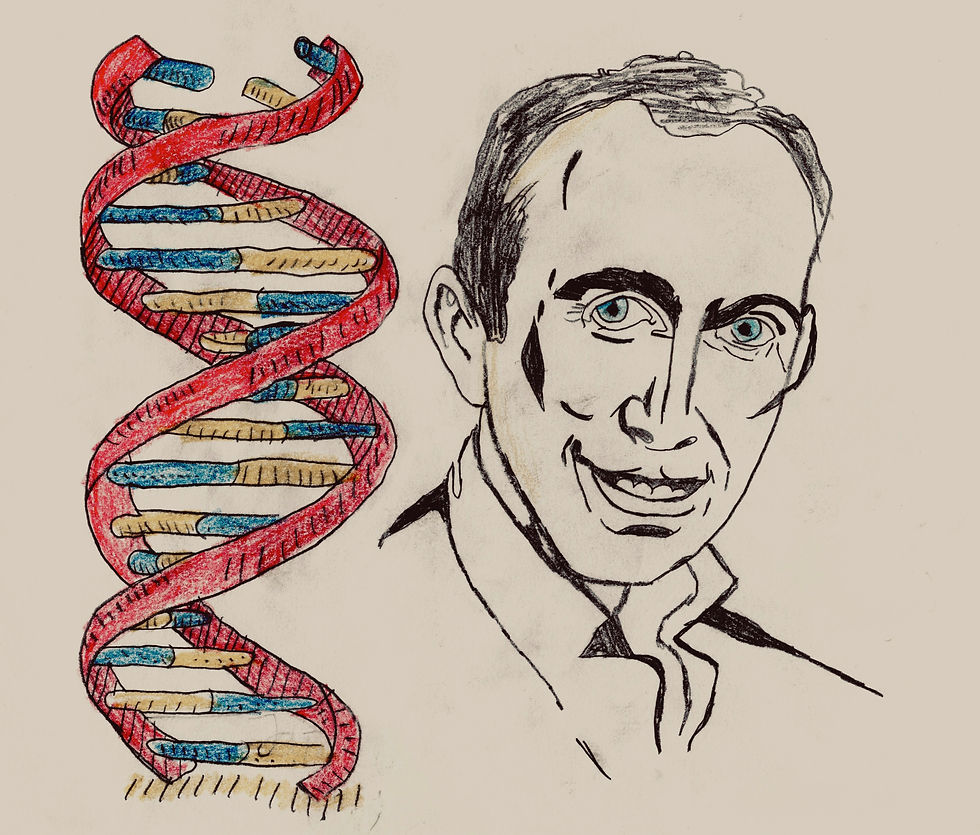
A sketch of James D. Watson by my 11-year-old son. (I’m super proud that he got the number of base pairs per turn accurate!)
When I first heard about the ‘Double Helix structure of DNA’, I was probably in grade 12. I don't remember my teacher expressing this as a great triumph in biology or even mentioning it as a great discovery story. The only thing I remember was that I liked drawing the double helix structure, particularly during exams where one can fill a whole page just to answer the question, “Describe semi-conservative replication.” It was only after my master’s when I wanted to start a research career that someone suggested this book called The Double Helix by James D. Watson. This was the very first discovery story most of our and previous generations read- simply because it was a big success and secondly, there are not many of them.
One might argue that Watson managed to be part of this discovery by just tagging along with Francis Crick. We make this judgement simply because we think of Watson as an ambitious but immature, competitive scientist driven by ego, intuition, and opportunism. This all could very well be true, but we always forget that we (I am only referring to people like me who never met him personally) create this image of Watson in our mind simply because of the self-portrait he created in the book, which is not always flattering. But we often forget that here is a man who entered university at the age of 15, finished his PhD at 22, solved the structure of DNA by 25, and won the Nobel Prize at 34. If you consider success to be nothing but being at the right place at the right time, no one can come close to Watson. Otherwise, how do you explain a virologist from the US, who got a fellowship to do postdoctoral training in biochemistry at Copenhagen, but decided to move to Cambridge within a year to learn X-ray crystallography?
Yet, we will not consider him as the greatest biologist or the greatest discoverer. He will never be considered the Einstein of biology, but I am not sure Watson really cared. All he wanted was to be the first person to solve the DNA structure and later to give an honest, personal, dramatic account of how the structure was solved. I often wonder what his biggest achievement is- solving the DNA structure or combining a major scientific breakthrough with raw human storytelling to write the book The Double Helix. Make no mistake, the DNA helix structure is arguably one of the biggest discoveries of the twentieth century. But it was intended to happen sooner or later. By 1950 it was clear that genes were made up of DNA, and to understand genetic information one must know the structure of DNA. So the timer was already on for the race- it was a matter of who finished first. Linus Pauling, the greatest chemist alive, also gave a shot at it. He was admired, feared, and considered almost unbeatable at molecular structures, as he had already solved the alpha-helix. If anyone could solve the DNA structure, it was him. But he ended up proposing a triple-helical model where the phosphate backbone was buried in the centre and the bases were hanging outside. Call it arrogance- he didn’t bother to verify his structure with X-ray crystallography data, the only experimental evidence for DNA structure at that time. Maurice Wilkins and Rosalind Franklin were also in the race. In fact, it was Wilkins’ crystallography data that Watson first saw at a meeting in Italy in 1951, which made him pursue the DNA structure and ultimately led him to Cambridge. But it was Rosalind Franklin, along with her student Raymond Gosling, who produced the sharpest X-ray diffraction image in May 1952- popularly known as ‘Photo-51’- on which Watson and Crick built their double helix model. Although Franklin and Wilkins had high-quality data, accurate measurements, and all the parameters confirmed, they failed to propose a structure. This could be due to many reasons: they couldn’t work together because of misunderstandings about their roles, clashing personalities, poor communication, and an unsupportive institutional environment. In the midst of this chaos, Watson and Crick found an opportunity and grabbed it.
I always wonder why the story of the DNA double helix got such attention. Thinking about it, it is still the best-selling scientific autobiography ever written. Commercially, it was a major bestseller, achieved mass-market appeal, and received unimaginable media attention. The book has remained in print ever since it was first published in 1968, and it is the best-selling scientific memoir ever written. But the question is- why? It’s not that we didn’t have scientific discoveries that matched its scientific importance. We had Oswald Avery, Colin MacLeod, and Maclyn McCarty’s famous experiment in 1944 showing that DNA, not protein, is the hereditary material. Then we had Matthew Meselson and Franklin Stahl in 1958, who, according to many, carried out the most elegant experiment in biology to prove that DNA replication is semi-conservative. Then we also had the sequencing of the human genome, which had its own ups and downs and a lot of public drama, some even involving James Watson. Yet, none of these discoveries became blockbuster stories.
Watson, to his credit, for the first time showed science as an emotional process, not just a logical one. Characters in the story, including Watson, were very different from the public’s idea of scientists as perfect, calm, rational figures. If you look at the main characters- James Watson, impulsive, energetic, and bold (resembling Veeru from Sholay, played by Dharmendra), and Francis Crick, rational, analytical, and stabilising (resembling Jai from Sholay, played by Amitabh Bachchan). Of course, some characters he portrayed in the book were very controversial, particularly Rosalind Franklin. He was widely and rightly criticised for portraying her in a sexist, dismissive manner, emphasizing her appearance rather than her scientific ability, and for underplaying her crucial contribution, especially Photo-51. Predictably, there was strong opposition to publishing the book, including from Francis Crick. Even Harvard University Press, which was originally supposed to publish it, pulled out due to complaints received about unfair portrayals and damage to the reputations of several scientists.
With all the controversies and criticism, the book made scientific discovery accessible to the general public. It showed creativity, competition, effort, and emotion behind a major scientific breakthrough as humanly as possible. Most importantly, this story inspired a whole generation of students to pursue molecular biology- and for that, we are grateful to James D. Watson.
--


